Annual performance reviews can provide organizations with evidence and data for certain types of decision-making, but they alone may not be sufficient to help employees improve their performance throughout the year.
If employees only receive feedback at the end of an evaluation period, issues that arose months prior may not have been resolved in a timely manner, while their performance, achievements, or work changes throughout the year may not be fully recognized.
Managers often have to gather a large amount of past data within a short period, making Performance Reviews more of a paperwork burden than a conversation focused on developing and supporting employee performance.
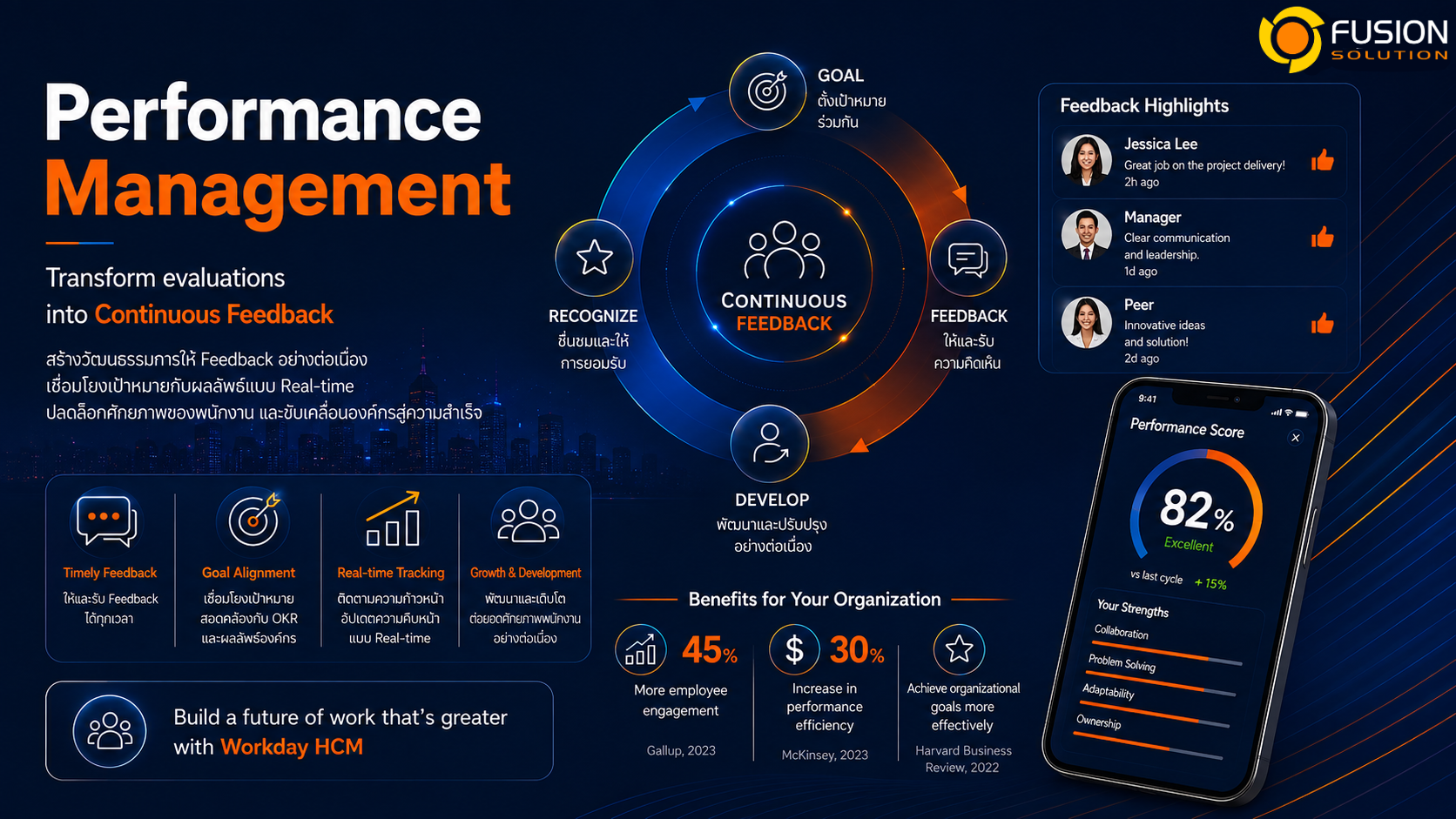
Performance management should therefore not be limited to evaluation forms or ratings, but should be an ongoing process that links goals, progress tracking, feedback, coaching, check-ins, and employee development.
What is Performance Management?
Performance Management is an ongoing process of setting goals, tracking progress, providing feedback to support development, and evaluating performance to ensure that employee work aligns with team and organizational goals.
SHRM explains that Performance Management is an ongoing process that encompasses the planning, monitoring, development, and evaluation of employee performance, with Annual Review being only one part of the overall system, not the entirety of Performance Management.
The CIPD states that Performance Management is not a single activity, but rather a group of practices that should be considered together, including setting objectives, supporting performance, holding accountable, learning and development, and regularly discussing performance.
How does Performance Management differ from Performance Appraisal?
Issue | Performance Appraisal | Performance Management |
Focus | Evaluate performance during a defined period | Manage and improve performance continuously |
Frequency | Annual or periodic | Throughout the year |
Activities | Formal review and rating | Goals, feedback, coaching, check-ins, development, and reviews |
Perspective | Primarily looks back at past performance | Connects current performance with future development |
Manager’s role | Evaluator | Provides clarity, feedback, coaching, and support |
Employee’s role | Receives the assessment | Participates in goal setting, progress tracking, and development |
Performance appraisal is also useful as a formal checkpoint for recording performance and supporting decisions regarding development, promotion, or compensation, but it shouldn't be the only time managers and employees discuss performance.
Limitations of annual performance evaluations
1. The feedback came too late
Feedback is most valuable when the recipient can still relate it to the situation and apply it. If you wait until the end of the year, the details and context may no longer be clear.
2. The goals may not be aligned with the current situation.
Strategies, priorities, and responsibilities can change throughout the year. If goals are set once and not reviewed, employees may still be evaluated based on goals that do not reflect their current performance.
3. Recency Bias can easily occur
Without continuous data, the manager may give more weight to recent events than to performance throughout the evaluation period.
4. Employees are unaware of their performance level
If expectations and feedback are not communicated consistently, the year-end evaluation may present a surprise instead of a summary of discussions throughout the year.
5. The manager must gather historical data
Summarizing a year's work from memory, emails, or files from multiple sources increases the workload and may lead to the omission of important information.
6. The conversation focuses more on rating than on improvement
When the system places too much emphasis on scores, discussions may turn into explaining the rating instead of planning how employees should improve.
What is Continuous Performance Management?
Continuous Performance Management is a performance management approach that uses goal setting, progress tracking, feedback, coaching, and check-ins regularly throughout the year, instead of relying on a single year-end assessment.
The term "continuous" doesn't necessarily mean holding weekly performance meetings for everyone, but rather creating a pace for discussion and data recording that suits the nature of the work, team, and goals.
- Clear and adjustable goals
- Regular Check-ins
- Timely Feedback
- Progress Updates
- Manager Coaching
- Employee Reflection
- Development Actions
- A performance review that uses cumulative data over the year.

What is Performance Check-in?
Performance check-in is a conversation between the manager and employees about goals, progress, obstacles, feedback, assistance needed, and future plans.
- Which goals are progressing according to plan?
- What has changed from the original priorities?
- What obstacles are affecting the performance?
- What kind of support do employees need?
- What feedback should we use for improvement?
- What skills should I develop further?
- What is the next task or goal?
- Who is responsible for each Action Item?
A good check-in should clearly indicate what the conversation leads to, not just a status report without any decision or follow-up.
What is Continuous Feedback?
Continuous feedback involves providing specific and up-to-date information to help employees understand what they are doing well, what needs improvement, and how to proceed.
- Related to tasks or observable behaviors.
- Provide clear context.
- Explain the impact.
- Provides practical guidelines.
- Allow the recipient to express their perspective.
- Focus on improvement, not criticism.
- It happened at the right time.
Continuous feedback shouldn't mean that giving it more often is better regardless of quality. Instead, it should be feedback that is relevant, clear, and helps the recipient take action.

What should a Performance Management system cover?
Goal Setting and Goal Alignment
Employees should see how their goals align with the team and the organization, and be able to review their goals as business priorities change.
Goal Progress Tracking
Managers and employees should be able to update progress, identify status, and record obstacles throughout the work cycle.
Feedback
The system should support the provision, request, and recording of task-related feedback to support discussions and development.
Check-ins และ One-on-Ones
There should be space to record discussion topics, progress, action items, and follow-ups without making the system unnecessarily burdensome to use.
Performance Reviews
Organizations can also use Formal Review to summarize performance within a defined period, based on information from Goals, Feedback, and Check-ins throughout the period.
Development Planning
The results of the Performance Discussion should be linked to the Learning or Career Development plan, not end with the Rating.
Performance History
Having historical data allows managers and employees to see progress, achievements, and issues that need further monitoring.
Reporting and Analytics
HR should have visibility into the evaluation cycle status, goal progress, check-in adoption, and other information necessary to improve processes.
The role of the Manager in Continuous Performance
Technology can help create workflows and visibility, but the quality of performance management still depends on the communication between the manager and the employees.
- Set clear expectations.
- Help align the team's goals with their priorities.
- Provide timely and specific feedback.
- Listen to the challenges and context of your employees.
- Provide resources and support for development.
- Follow Action Items
- Communicate when goals change.
- Separate coaching from criticism.
How can AI help with Performance Management?
AI can help reduce the burden of data collection and organization, but it should not automatically judge performance for managers or the organization.
- Please summarize the information from Check-ins.
- Please help structure the feedback draft.
- Please compile a Goal Progress report.
- Help remind me of Action Items.
- Please help me find related content or learning resources.
- Please help prepare the starting data for the Performance Review.
The use of AI should include human review, data governance, and job-related criteria to ensure managers remain accountable for feedback and decisions.
How to switch from Annual Review to Continuous Performance Management
1. Define the objectives of Performance Management.
The organization must be clear whether this process is used for alignment, development, accountability, talent decisions, or a combination of multiple objectives.
2. Review the objective structure.
Goals should be clear, aligned with the task, and adaptable as the business context changes.
3. Establish an appropriate check-in time.
It's not necessary to use the same frequency for all teams. Consideration should be given to the nature of the work, the project duration, and the needs of the employees.
4. Reduce the burden of paperwork.
Focus on information that improves conversation and decision-making. Eliminate forms or processes that aren't actually used.
5. Develop Manager Capability.
Managers need guidance on setting goals, providing feedback, coaching, and managing difficult conversations.
6. Establish a channel for continuous data recording.
Goals, Feedback, Check-ins, and Action Items should be stored in a searchable and reusable system.
7. Link Performance with Development.
Issues identified during check-in should lead to appropriate learning, coaching, assignment, or development plans.
8. Measure both the process and the outcome.
It is important to monitor the completion of the review, the quality of the conversation, the clarity of the goals, the tracking of action items, and support for development.
Continuous Performance doesn't mean having more meetings.
Switching to Continuous Performance Management shouldn't create unnecessary meetings or forms.
- When the goal changes.
- When the project reaches a milestone.
- When employees need feedback.
- When encountering obstacles
- When there is important work
- When it is necessary to review the Development Plan.
A good system should help reduce administrative work and make information ready for discussion, not turn a single Annual Review into multiple forms per year.
Summary
Performance Management is an ongoing process of setting goals, monitoring performance, providing feedback to support development, and evaluating results in alignment with organizational goals.
The Annual Performance Review also plays a role as a formal checkpoint, but it shouldn't be the only time managers and employees discuss performance.
Continuous Performance Management helps create clarity throughout the year through goals, check-ins, feedback, coaching, and systematic tracking of action items.
For organizations that want Performance Management to support both performance and growth, the starting point isn't about adding forms, but about creating quality, timely conversations that lead to real action.