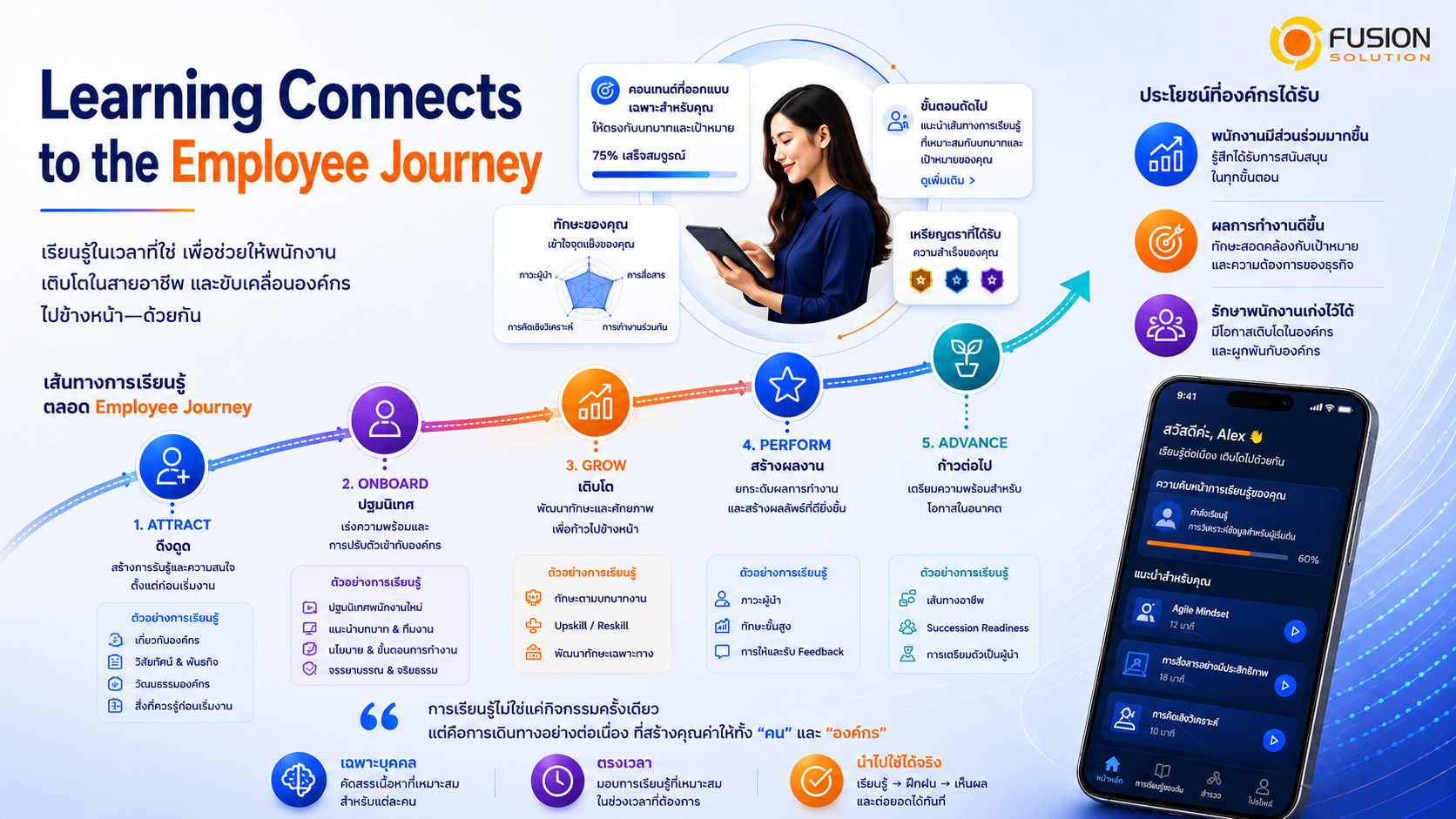
Many organizations invest heavily in employee training, but the results may not be as clear as expected. Some employees receive courses irrelevant to their work, while others enroll because it's required training, without seeing a connection to their career goals or path.
This problem often arises from designing a uniform learning approach for everyone, rather than designing it based on the skills employees already possess, the skills the job requires, and the skills the organization will need in the future.
When learning is not linked to role, skills, performance, and career development, it may become merely a fulfillment task rather than a process that helps employees grow and prepares the organization for change.
Modern Learning Management should not be viewed merely as a system for storing courses or training records, but rather as a platform that connects learning with employees' skills, jobs, goals, and growth.
What is Learning Management?
Learning Management is the process and system that helps organizations design, manage, deliver, track, and measure employee learning to develop the skills, knowledge, and abilities necessary for current and future work.
From the HR and L&D perspective, a Learning Management system shouldn't just be responsible for storing course lists, but should also help answer important questions such as:
- What does each group of employees need to learn?
- What skills are key to achieving business goals?
- Where is the skill gap among the employees?
- What learning content should be recommended to whom?
- How does learning affect performance or career development?
- Is the organization tracking all aspects of Compliance Training?
- Which learning programs should be improved or discontinued?
Workday states that Workday Learning integrates learning into a single platform and mentions AI authoring, personalized AI tutors, skills intelligence, real-time insights, and compliance support as core capabilities of the learning system.
Why is general training not enough?
1. The employee received a training course that was not relevant to the job.
When an organization uses the same training catalog for a large number of employees, some groups of employees may receive courses that are irrelevant to their actual roles, leading them to undervalue the learning process.
2. Learning is not linked to the Skill Gap.
If an organization doesn't know what skills its employees possess and which skills need to be developed further, the choice of training courses may be based more on feelings or popularity than on data.
3. Low engagement.
Employees are likely to be uninterested in learning unless they see that the content helps them work better, grow in their careers, or solve real pain points.
4. L&D is difficult to measure.
Measuring only the number of participants or the completion rate may not tell organizations whether the learning is actually improving skills, enhancing performance, or supporting business goals.
5. Content becomes outdated quickly.
In an environment where jobs and technology change rapidly, outdated learning content may no longer be relevant to the new roles, tools, or skills that businesses require.
6. Learning is separate from the Employee Journey.
If learning isn't linked to onboarding, performance, career development, or internal mobility, employees may not see learning as a part of their growth within the organization.

What is skills-based learning?
Skills-Based Learning is a learning approach designed based on employees' existing skills, the skills required for the job, and the skills the organization will need in the future. This ensures that learning is better aligned with employees' roles, goals, and growth paths.
This approach shifts the question from "What training courses should employees take?" to "What skills do employees need to develop in order to work, develop, and grow better?"
Workday states that Skills Cloud uses AI to surface and analyze the connections between skills within an organization, helping organizations identify, track, and develop critical skills that are important to business goals.
What is Personalized Learning?
Personalized learning means providing learning content or a learning journey tailored to each employee's role, skills, interests, goals, and context.
Personalized learning doesn't mean everyone needs a completely personalized course, but rather that it makes learning more relevant, such as:
- Suggest courses categorized by job role.
- Course recommendations based on Skill Gap.
- We recommend courses based on your career interests.
- Introducing courses from Performance Discussion.
- Introducing courses from the Internal Mobility pathway.
- Introducing the Learning Journey for new employees.
- Suggest content based on Compliance or Location.
How should Learning be linked to the Employee Journey?
1. Onboarding
New employees should receive learning content relevant to their role, team, tools, and the foundational knowledge necessary to start work, not generic courses that are the same for everyone.
2. Performance Management
When Performance Check-in detects a Skill Gap or Development Need, the Learning system should help connect to the relevant course or content.
3. Career Development
Employees seeking career advancement should identify what skills they need to develop and what learning paths will help them get closer to that goal.
4. Internal Mobility
When organizations want to support internal growth, learning should help employees see opportunities and prepare the skills for new roles.
5. Compliance
Learning must also support required training such as compliance, security, policy, or regulatory training, and must have a clear completion and audit trail tracking system.

What should a Learning Management System include?
- Learning Catalog
Organizations should have a centralized area for learning content such as courses, videos, articles, guides, workshops, virtual classrooms, or on-demand learning. - Personalized Recommendation
The system should suggest content relevant to the employee's Role, Skill, Career Interest, or Learning Need. - Skills Intelligence
Learning should use skills data to recommend courses, analyze skill gaps, and track skill development. - Learning Assignment
HR and L&D should be able to assign learning to employees based on their roles, departments, positions, locations, or compliance requirements. - Learning in the Flow of Work
Learning should be accessible when employees need it, not isolated in a system that nobody uses. - Authoring และ Content Creation
L&D and Subject Matter Experts should be able to create or update content quickly so that it is relevant to the work context. - Analytics และ Insights
Organizations should view the completion, engagement, compliance, skill development, and effectiveness of their learning programs. - Governance และ Compliance
The learning system should support the management of Required Training, Completion Tracking, Audit Trail, and Reporting for Compliance.
How does skills-based learning help organizations?
Develop skills that are relevant to real-world jobs.
When learning is linked to skills and roles, employees receive content that is more aligned with what they need for their jobs.
Add Learning Engagement
Employees are more likely to be interested in learning when they see that the course is relevant to their work, the problems they face, or their own growth path.
Supporting Upskilling and Reskilling.
Organizations can prepare employees for new jobs, new technologies, or changing roles.
Connecting Learning with Performance
The skill gap identified during the performance discussion can lead to a clearer learning or development plan.
สนับสนุน Internal Mobility
When organizations see employees' skills, and employees see the skills that need to be developed, internal mobility or growth can become more systematic.
Helping L&D create business value.
CIPD states that L&D can create value and impact when focusing on skills development, and that skills development is critical to performance, workforce resilience, and the future of work.
Why is Learning Needs Analysis important?
Learning Needs Analysis is the process of identifying what knowledge, skills, or abilities employees, teams, or organizations need to develop in order to align with business goals and future needs.
A good Learning Needs Analysis should consider:
- business goals
- Skills that organizations need
- Skills that the employee possesses.
- Performance Gap
- Role Requirement
- Compliance Requirement
- Future Capability
- Feedback from the Manager and employees.
- Data from Performance and Workforce Analytics.
How can AI help with learning?
AI can help make learning more personalized and adaptable, but it should be used to support learning, not replace, human learning strategy design.
- Course recommendations based on Role and Skills.
- Suggesting a Learning Path based on a Skill Gap.
- Please help create a draft of the course content.
- Please summarize or revise the Learning content.
- Help answer questions during class
- Help find relevant content
- Please analyze Engagement and Completion.
- Please help connect Learning with Career Development.
How to transition from a Training Catalog to Skills-Based Learning
- Identify the organization's key skills.
Start by identifying the critical skills that businesses need, both now and in the future. - Connect Role with Skills
Each role should have a clear skill profile to be used in planning the learning path and development plan. - Conduct Learning Needs Analysis regularly.
It shouldn't be done only once a year, but should utilize data from Performance, Manager Feedback, Business Priority, and Workforce Data. - Group Learning Content by Skills
Instead of organizing courses solely based on general categories, they should be linked to skills that can be developed. - Create a Personalized Learning Journey
Give each employee group a learning path that is relevant to their job and their goals. - Connecting Learning with Performance and Career.
When developing skills from Performance Check-in or Career Conversation, there should be a Learning Recommendation available immediately. - Measure results rather than just completion.
You should look at engagement, skill progress, application to work, manager feedback, and impact on performance, not just the number of graduates.
Effective learning isn't just about completing all the courses.
Valuable learning should help employees perform better, better understand their roles, develop skills the organization needs, see their growth path, adapt to change, and connect learning with performance and career.
For an organization, effective learning should help create a workforce ready for change, reduce skill gaps, support internal mobility, increase engagement, enhance competitiveness, and use data to develop better talent strategies.
Summary
Learning Management is the process and system that helps organizations manage employee learning, from content design and delivery to follow-up and measuring learning outcomes.
The problem with conventional training is that it often doesn't connect to the skills required for the job, resulting in low engagement and difficulty in measuring business impact.
Skills-Based Learning and Personalized Learning help organizations develop employee skills more effectively by connecting learning with roles, skills, performance, career development, and organizational goals.
For organizations looking to build a future-ready workforce, shifting from a training catalog to skills-based learning is a crucial step in digital HR transformation.