
A new employee's first day shouldn't begin with confusion, a flood of documents, or waiting for information from multiple parties. However, in many organizations, the onboarding process is still filled with manual tasks scattered across emails, Excel spreadsheets, paper documents, and coordination between HR, IT, Finance, managers, and other relevant teams.
Without clear standards, each new employee may have a different experience. Some receive complete information before starting work, while others have to ask what to do next. Some may not even receive equipment, system accounts, or crucial information on their first day.
These issues affect not only the convenience of HR but also impact the new hire experience, readiness for work, sense of connection with the organization, and confidence of new employees from the start.
Therefore, onboarding is not just about filling out paperwork or conducting an orientation, but rather a process of designing the new employee experience from the moment they accept an offer until the point where they can start working, understand their roles, and connect effectively with the organization.
What is Onboarding?
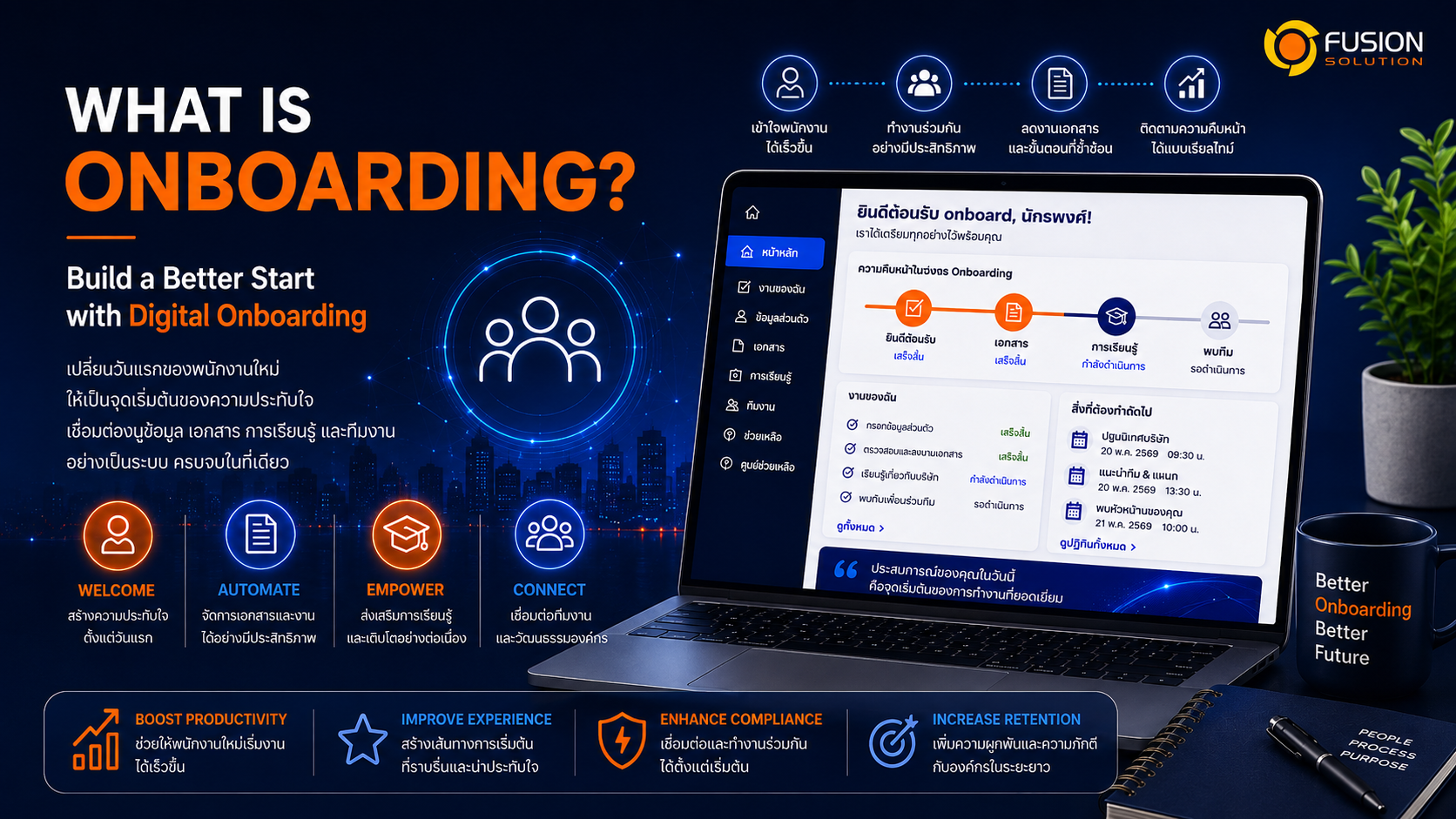
Onboarding is the process of welcoming, preparing, and helping new employees learn their roles, team, organizational culture, work tools, and necessary processes so that they can start work confidently and effectively.
SHRM explains that onboarding is the process of integrating new employees into the organization, including orientation and opportunities to learn about the organizational structure, culture, vision, mission, and values.
CIPD explains that Employee Induction, or Onboarding, is the process that helps employees learn about their new role and new employer. A good start can help new employees be welcomed, understand necessary information, and adapt to the organization.
Therefore, a good onboarding process should encompass both practical information, such as documentation, benefits, equipment, and work systems, as well as experiential information, such as organizational culture, teams, role expectations, and how to work together.
Onboarding begins after accepting an offer.
Many organizations understand that onboarding begins on the first day of work, but in reality, the experience for new employees starts from the moment the applicant accepts the offer.
If information from the Talent Acquisition process is not continuously passed on to the Onboarding team, the organization may experience gaps between recruitment and actual onboarding, such as incomplete employee data, incomplete documentation, or relevant teams not receiving necessary information.
Workday Onboarding Plans outline how to create a seamless onboarding experience from candidate to fully onboarded through seamless and personalized experiences, including preboarding and onboarding tailored to the role and stage of employment.
How does onboarding differ from orientation?
Issue | Orientation | Onboarding |
Focus | Introducing the organization and basic information | Prepare for the short-term and long-term. |
period | First day or first week | From before starting work until several months after starting work. |
content | Documents, policies, welfare regulations, and rules. | Roles, team culture, goals, tools, and monitoring. |
Related people | HR mainly | HR, Manager, IT, Finance, Buddy, Team, and Executives |
Target | Provide basic information | It helps new employees get started quickly, engage, and adapt well. |
SHRM states that onboarding is often confused with orientation. While orientation is necessary for managing documents and basic tasks, onboarding is a more comprehensive process that involves managers and other employees within the organization as well.
Why is manual onboarding problematic?
1. The process is scattered across multiple channels.
When HR has to send numerous emails, request information from various departments, and track statuses through separate files, the chances of some steps being missed increase.
2. The experience of new employees is inconsistent.
If each department or manager uses a different onboarding method, new employees may receive different amounts of information and have varying levels of readiness to start work.
3. Paperwork takes up too much time.
New employees may have to fill out the same information multiple times, while HR has to check, track, and file the documents themselves.
4. IT and support departments received the information late.
Without a coordinated workflow, the IT team may receive information late, resulting in user accounts, devices, or system access permissions not being ready on the first day.
5. The manager has no visibility.
Managers may not be aware of which steps new employees have completed or what information is still missing, leading to discontinuity in initial team preparation and goal setting.
6. New employee information is not linked to the main system.
If data from the recruitment, onboarding, and core employee information systems are not interconnected, organizations may have to re-enter data and risk errors in employee data. This is where Core HCM plays a crucial role, as it's a central system that ensures employee data, organizational structure, job titles, and key information for new employees are linked from the very beginning.
7. It is difficult to measure onboarding performance.
When data is scattered across multiple locations, it can be difficult for organizations to analyze how long the onboarding process takes, which steps are experiencing delays, or where new employees are encountering problems.
How does poor onboarding negatively impact an organization?
Onboarding is one of the first experiences new employees have after deciding to join an organization. If this experience is not good, the organization may lose the opportunity to build trust from the very beginning.
SHRM states that quality onboarding is critical to the long-term success of new employees, employee experience, and employee retention within the organization.
CIPD states that employees' first impressions of an organization can affect job satisfaction and adaptation to the organization. Effective induction or onboarding helps new employees be welcomed and provided with the necessary information for their work.
- The new employee started work later than they should have.
- The manager needs to spend more time answering basic questions.
- HR has to follow up on tasks multiple times.
- New employees feel unsure about what to do next.
- Important information missed
- Employee experience varies depending on the team.
- The organization missed the opportunity to build engagement from the very beginning.
What is Digital Onboarding?
Digital Onboarding is the use of technology to systematically design and manage the journey of new employees, from preboarding, day one, role readiness, learning, task completion, manager check-in, to monitoring readiness after starting work.
Digital onboarding is not just about putting documents online; it's about creating a clear path outlining what new employees need to do, when, who is responsible, and what information should be forwarded to the relevant systems or teams.
Workday Onboarding Plans outline how to create a seamless onboarding experience from candidate to fully onboarded through seamless and personalized experiences, including preboarding and onboarding sessions with content appropriate to the role and stage of onboarding.

What should a Digital Onboarding Journey include?
1. Preboarding
- Work start date information
- Documents that must be prepared
- Information about the workplace or type of work.
- Welcome message from the organization or team.
- Manager or Buddy information.
- Login link or related portal.
- Things to do before the first day
2. Day One Experience
- Welcome Message
- Agenda for the first day
- Team introduction
- Access to main system
- Employee handbook
- Necessary policies
- Device settings
- Important tasks that need to be done.
3. Role Readiness
- Roles and Responsibilities
- Goals for 30/60/90 days
- Tools required
- Key team workflow.
- Main stakeholders
- work standards
- Channels for requesting help
4. Learning and Knowledge Access
- Knowledge about the organization
- Work system
- policy
- Safety
- Position-specific skills
5. Manager Check-in
- Talking about duties
- Standards and Expectations
- Team introduction
- Support channels
6. Progress Tracking
- Completed Task
- Missing documents
- System activation status
- Learning Course
- Manager Check-in
- The process took an unusually long time.
Workday Journeys and the Onboarding Experience
Workday Journeys states that it can help organizations create tailored and concierge-style experiences for employees, guiding them through moments that matter and using data from Workday to make the Journey Path relevant to each individual employee.
In the context of onboarding, this concept helps organizations design differentiated journeys based on job roles, departments, workplaces, countries or subsidiaries, position levels, work styles, and onboarding dates.
It is important that the onboarding journey is not a one-size-fits-all checklist, but rather an experience with steps and information tailored to the context of each group of new employees.
How does Digital Onboarding help HR and organizations?
Reduce the manual workload of HR.
Once task and workflow documents are organized within the HR system, there's no need to track every step via separate emails or files.
Establish standards for all organizations.
Although each role may have a different journey, every journey can be clearly structured, with defined steps and ownership of the work.
Make sure new employees know what to do next.
Self-service and guided journeys help new employees access tasks and information in a structured manner, without having to wait for HR to send step-by-step instructions.
This makes the role of the Manager clearer.
Managers can prepare goals, learning plans, and conduct check-ins in a more systematic way.
Link data with other systems.
When Onboarding is integrated with Core HCM, Recruiting, Learning, and other systems, new employee data flows more efficiently and reduces duplicate data entry.
Results can be measured and improved.
Analytics helps organizations see which parts of the journey are problematic, which steps are slow, or which groups of new employees may need additional support.
A good onboarding process should begin before Day One.
Many organizations begin onboarding employees on their first day of work, but in reality, the new employee experience starts after they accept the offer.
SHRM states that some organizations begin onboarding after the offer is accepted but before the start date, using preboarding to connect new employees with the organization, such as sending information for review, pairing buddies, or preparing information for the first day.
Deloitte states that onboarding should be viewed as a process that helps employees transition from the point of receiving a job offer to their first year or more, and should be designed to be more worker-centric rather than simply a transactional task.
Therefore, a good onboarding experience shouldn't just be the first day, but a journey that begins before the first day and continues until the employee can work confidently.
Guidelines for preparing an organization before implementing Digital Onboarding.
1. Mapping the current Onboarding process.
Organizations should document every step, from Offer Accepted to the post-project start date, to see who is handling each task, which system is being used, and where delays occur.
2. Assign tasks according to the client.
Onboarding is not solely the responsibility of HR. The roles of HR, Manager, IT, Finance, Buddy, and other relevant teams should be clearly defined.
3. Define the journey according to employee groups.
Office staff, consultants, sales staff, managers, or international staff may require different information and procedures.
4. Connected to Core HCM and Recruiting.
Information from the recruitment process should be passed on to the Employee Record and used as starting data for onboarding.
5. Reduce unnecessary information on the first day.
Prioritize information to determine what's essential before starting work, what should be provided on the first day, and what should be learned after starting the job.
6. Use learning and content appropriately for your role.
New employees should receive learning content tailored to their position, team, and responsibilities, not generic content that's the same for everyone.
7. Continuously measure onboarding performance.
Organizations should measure task completion, time taken for each step, employee feedback, manager feedback, and the readiness of new employees.
A good onboarding experience is the starting point of an employee experience.
Onboarding is a crucial period for organizations to build trust, as new employees are seeking direction, clarity, and signals of organizational support.
If organizations design their onboarding process as a clear digital journey, new employees won't have to start by searching for information themselves. Instead, they can follow a pre-designed path, knowing what they need to do, who can help, and what the expectations are.
This is why onboarding should be viewed as part of the employee experience, not just an HR operations task.
Summary
Onboarding is a crucial process that helps new employees learn the roles, organization, teams, tools, and expectations necessary for a confident start to their careers.
Manual and non-standardized onboarding processes often lead to HR having to redo tasks, new employees having inconsistent experiences, managers lacking visibility, and data not being connected to the main system.
Digital Onboarding transforms the onboarding process from a scattered task list into a guided journey that connects Preboarding, Day One, Learning, Manager Check-in, Task Completion, and Analytics.
For organizations looking to elevate the employee experience, starting with a standardized and personalized onboarding process is one of the key elements that can yield results from day one.